
Blog
The Invisible Language of Nature, Inside Our Semiochemicals Deep Dive
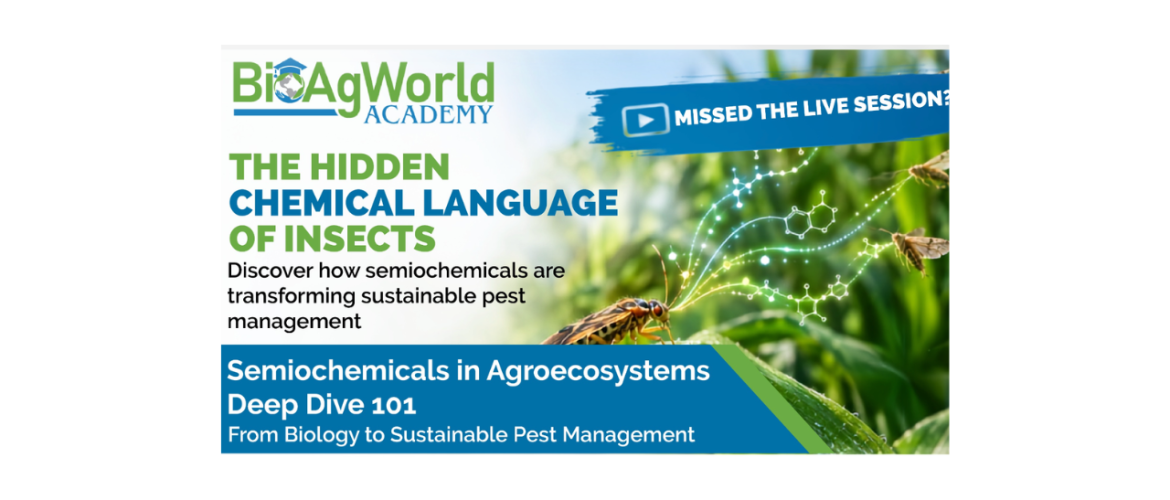
Walk into a typical agricultural field on a quiet morning, and it might seem incredibly still. But right beneath our level of human perception, a complex and high-stakes conversation is taking place every single second.
For a long time, we thought of plants as passive organisms simply waiting to be consumed by pests. We now know this could not be further from the truth. To survive in a harsh world, plants have developed vast chemical vocabularies to interact with their environment, deter enemies, and even recruit biological allies to protect them. Insects have evolved to intercept, interpret, and sometimes weaponize these exact same signals.
It is a fascinating and completely invisible arms race. These unseen drivers of the agricultural biome are known as semiochemicals, derived from the Greek word meaning signal.
We recently explored this fascinating hidden world in our BAW Academy course: Semiochemicals in Agroecosystems Deep Dive 101: From Biology to Sustainable Pest Management. Led by Knowledge and Training Partners including Dr. Markandeya Gorantla of ATGC Biotech and Thaís Andrade, PhD. of Provivi, the sessions explored how these chemical signals influence interactions within agroecosystems, and why understanding those interactions is opening entirely new possibilities for targeted pest management.
To give you a glimpse into this incredible learning experience, we have put together a Q&A based on some of the most impactful and mind-blowing moments from the course.
What exactly is chemical espionage in the field?
One of the most striking concepts discussed during the training was how pests have evolved to turn a plant’s own defense mechanisms against it. It is a biological phenomenon known as chemical espionage, and it is genuinely awe-inspiring to learn about.
When certain plants or trees are stressed by an attack, they release natural defensive signals into the air. You would think this defense mechanism keeps them safe. However, certain insects have actually learned to intercept this specific chemical distress signal.
Nature always takes things a step further. Through microscopic processes in the insect’s gut, the plant’s natural defense signal is converted into a highly potent aggregation pheromone. The pest essentially uses the host’s own chemistry to broadcast a signal that calls thousands of other pests to the vulnerable plant. Understanding these incredibly specific interactions is the first crucial step in learning how we can disrupt them to protect our crops.
How does this shift our approach to sustainable pest management?
When we think about pest control, we usually think about lethal toxicity. We think about spraying a field with harsh substances to completely eliminate a threat. But semiochemicals represent a massive paradigm shift in how we approach agriculture. Instead of relying on broad-spectrum lethal control, we are utilizing smart behavioral management.
During the sessions, we looked closely at integrated strategies that flood the biome with synthetic signals. This completely scrambles a pest’s natural host-location mechanisms. Instead of relying on a single toxic approach, we can combine distinct biological tactics to create a robust and environmentally friendly defense.
This was one of several fascinating relationships explored more deeply during the BAW Academy course. We learned how we can deploy targeted signals that confuse male pests and prevent successful reproduction. We can also create false plant trails that draw pests away from valuable crops, or we can deploy natural repellents that trick pests into believing a host plant is already overcrowded. It is about outsmarting the pest instead of just overpowering it.
Why is the exact shape of a chemical so critical?
This was one of those moments in the course that truly highlighted the precision of nature. When creating pheromones for agricultural use, it is not just about getting the chemical formula right on paper. The actual physical three-dimensional shape of the molecule matters immensely.
Insect olfactory receptors are incredibly precise. The course detailed how the positive and negative versions of a molecule, which are essentially mirror images of each other, can trigger vastly different behavioral outcomes in an insect.
Think of it like a lock and a key. If a manufacturer gets the structural chemistry even slightly wrong, the key will not fit the lock, and the product simply will not work in the field. This biological reality separates highly effective bio-agriculture solutions from failed experiments. For professionals interested in moving beyond the basic definition of semiochemicals, the full session explores these relationships in much greater depth.
How can these solutions be applied on massive farms?
Understanding the biology is thrilling, but it is only half the battle. One of the main barriers to global adoption is product performance and application scalability. If a solution cannot be efficiently deployed across hundreds of hectares, it holds limited practical value for the large-scale farmer.
The training led a highly practical and eye-opening discussion on modern application methods. We are moving far beyond the days of manually tying small dispensers to individual tree branches by hand.
We were fascinated by the breakdown of mechanized and aerial integrations. The sessions detailed how tractor-mounted systems can now deploy specialized granules and sprayables with incredible field efficiency and uniformity. For massive operations, fixed-wing aircraft can treat large and otherwise inaccessible areas. Furthermore, drone-based applications are leveraging precision agriculture tools for highly targeted and site-specific deployment. This radically reduces waste while maintaining high efficacy.
Does behavioral control replace traditional field scouting?
This is a fantastic question that surfaced during a module quiz in the course, and it highlights a major shift in agronomic thinking.
The answer is a definitive no. Behavioral controls like mating disruption prevent reproduction, but field monitoring remains absolutely essential. You still need to evaluate actual pest pressure, assess the performance of your treatment, and determine if traditional threshold-level interventions are required. Behavioral control enhances Integrated Pest Management, but it never replaces the foundational agronomic practices of a good farmer.
Understanding the global regulatory landscape
The course did not shy away from the business and regulatory realities of biologicals. If we want to revolutionize agriculture, we have to know how to bring these products to market safely and legally.
We spent significant time examining the distinct differences between various global baseline regulatory frameworks. Understanding the precise requirements for product identity, preliminary batch analysis, and manufacturing protocols is just as critical to a solution’s success as the science itself. Without a firm grasp of these global registration requirements, even the best science will stay trapped in the laboratory.
Continue Exploring with BAW Academy
What we have shared here is only a tiny glimpse of the rich conversations, biological mechanisms, and commercial realities explored throughout the sessions. The transition toward sustainable pest management requires more than just knowing a few new concepts. It requires specialized knowledge and a deep, empathetic understanding of how these delicate ecological systems actually function.
If the role of chemical communication, synthetic false trails, and advanced drone applications has sparked your curiosity, the complete BAW Academy course takes the discussion much further.
We invite you to explore the full course, learn directly from industry experts, and dive deeper into the science and practical possibilities of behavioral pest management.
Explore the Course → Semiochemicals in Agroecosystems Deep Dive 101: From Biology to Sustainable Pest Management