
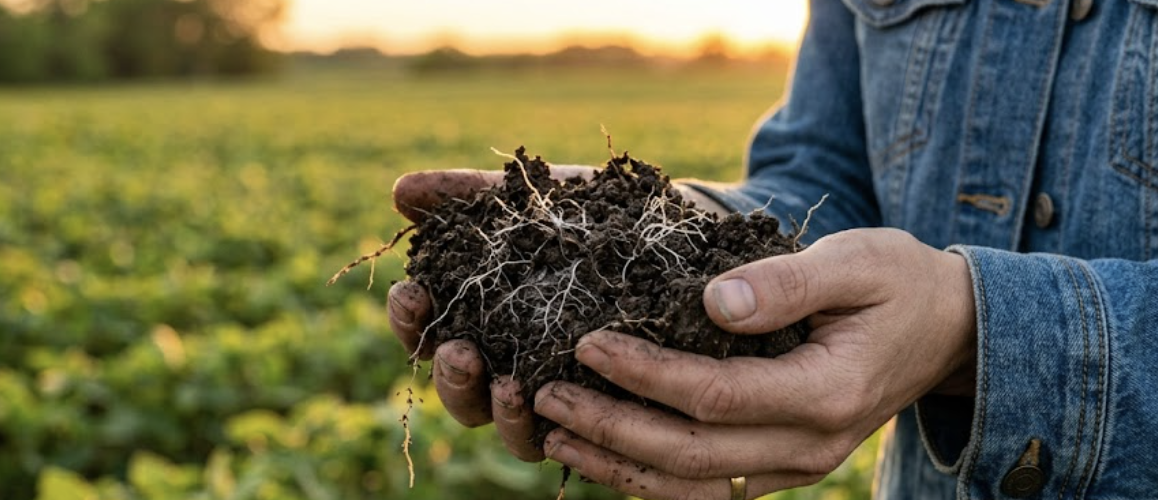
Smart Soil Health Management: 7 Natural Strategies Agronomists Swear By
Take a walk into any conventional, heavily tilled field during a dry spell, and you will notice something unsettling: silence. The dirt feels like dust, it smells like nothing, and when it rains, water pools on the surface rather than sinking in. Conversely, when you step into a field managed by biological principles, the ground yields slightly beneath your boots. It smells like deep, earthy rain, and it teems with invisible life. The difference between these two fields comes down to one critical practice: smart soil health management.
For decades, we treated soil like a lifeless sponge that merely held chemical fertilizers upright. Consequently, we depleted the very biological engines that make agriculture sustainable. Today, forward-thinking agronomists recognize that true yield stability requires managing the living ecosystem beneath our feet. If you want to move beyond treating symptoms and start building resilient, high-yielding crop systems, you must understand the natural strategies driving the future of agriculture.
What Is Smart Soil Health Management?
Smart soil health management is the proactive, science-driven practice of optimizing the physical, chemical, and biological properties of soil to create a self-sustaining ecosystem for plant growth. Instead of relying solely on synthetic inputs to force crop yield, this approach utilizes natural soil regeneration strategies to unlock locked nutrients, improve water retention, and build disease-suppressive environments.
Think of the soil as a plant’s digestive system. If a human takes antibiotics every day, their gut microbiome collapses, leading to systemic illness. Similarly, when a field faces continuous deep tillage and heavy chemical salt applications, the soil microbiome perishes. Smart soil health management acts as the agricultural equivalent of prebiotics and probiotics. It restores the microbial workforce.
Importantly, this management style is not about abandoning modern agriculture; it is about elevating it. Agronomists achieve this by balancing crop removal rates with biological inputs. By fostering an environment where bacteria, fungi, protozoa, and nematodes thrive, farmers can naturally cycle nutrients. Therefore, implementing these sustainable agriculture practices ensures that the farm remains profitable not just for the next harvest, but for the next generation.
The Biological Engine: How Agronomists Rebuild Soil Naturally
To successfully implement smart soil health management, professionals must shift their focus from mere chemistry to applied biology. Managing soil biology requires understanding the complex underground economy where plants trade liquid carbon (exudates) for vital minerals mined by microbes.
Top agronomists rely on several natural strategies to rebuild this biological engine:
- Maximizing Root Exudates: By keeping living roots in the ground year-round through cover cropping, agronomists ensure a continuous food source for microbial soil amendments to thrive.
- Deploying Mycorrhizal Fungi: These beneficial fungi physically extend the plant’s root system, accessing water and phosphorus that plant roots alone cannot reach. Understanding the exact role of mycorrhizae in soil regeneration is critical for drought resilience.
- Integrating Biofertilizers: Instead of dumping synthetic nitrogen, experts use nitrogen-fixing bacteria and phosphorus-solubilizing microbes to make existing soil nutrients bioavailable.
- Fostering Soil Aggregation: Bacteria produce sticky “glues,” while fungal hyphae act as microscopic ropes, binding soil particles together to prevent erosion and improve water infiltration.
How do biostimulants improve soil structure?
Biostimulants improve soil structure by stimulating native microbial populations to produce glomalin and other extracellular polymeric substances (EPS). These natural biological glues bind individual sand, silt, and clay particles into larger, stable aggregates. Consequently, this improved aggregation creates larger pore spaces within the soil profile. These pores allow oxygen to penetrate deeper and dramatically increase the soil’s water-holding capacity, ultimately creating a highly structured, sponge-like environment that resists compaction and erosion.
Field Results: Natural Soil Regeneration Strategies in Action
Theory means little without field application. Across the globe, smart soil health management is delivering measurable, economic results for commercial growers.
Consider a recent large-scale maize operation transitioning to sustainable agriculture practices. By replacing 30% of their synthetic nitrogen program with a targeted consortium of biofertilizers and amino acid-based biostimulants, the farm maintained identical crop yields while significantly reducing input costs. Furthermore, soil tests revealed a 15% increase in native microbial biomass after just two growing seasons.
Another striking example involves the use of arbuscular mycorrhizal fungi (AMF) in drought-stressed tomato crops. According to peer-reviewed research available via ScienceDirect, plants inoculated with specific mycorrhizae maintained physiological functions during severe water deficits much longer than untreated controls. The fungal networks physically bridged the gap between roots and receding moisture lines.
Additionally, regulatory and industry bodies recognize this shift. The European Biostimulants Industry Council (EBIC) actively highlights how biological inputs improve nutrient use efficiency, a core tenet of modern regenerative frameworks. Globally, the Food and Agriculture Organization (FAO) warns that without building soil organic matter biologically, global food security remains at risk. These aren’t just fringe theories; they are the documented foundation of future agronomy.
Expert Q&A Deep Dive: Mastering Soil Biology
A: Smart soil health management is the integration of biological, chemical, and physical farming practices to maximize a soil’s natural ability to support crops. It involves minimizing mechanical disturbance, maintaining continuous living plant cover, and utilizing biological inputs like biostimulants and biofertilizers. Ultimately, it shifts the farming focus from feeding the plant directly to feeding the soil microbiome, which then feeds the plant.
A: You improve soil health naturally without losing crop yield by taking a phased, transitional approach rather than quitting synthetic inputs cold turkey. First, integrate multi-species cover crops to build organic matter and suppress weeds naturally. Next, introduce targeted microbial soil amendments, such as mycorrhizae and nutrient-solubilizing bacteria, to increase the efficiency of the fertilizers you are already applying. This allows you to gradually dial back synthetic inputs as biological nutrient cycling takes over.
A: The best natural strategies for agronomists treating compaction involve biological tillage rather than mechanical deep ripping. Planting deep-rooted cover crops, such as tillage radishes or cereal rye, physically punches through hardpans. Simultaneously, applying fungal-dominant biostimulants encourages hyphal network growth, which aggregates soil particles and creates lasting macro-pores for air and water infiltration.
A: You measure soil microbiome health accurately by moving beyond standard NPK chemical testing and utilizing biological assays. The Haney Test is a premier tool, as it measures water-extractable organic carbon and tracks microbial respiration (the amount of CO2 the soil exhales). High respiration rates, combined with a balanced predator-to-prey ratio seen in direct microscopy, definitively indicate a thriving, healthy soil microbiome.
A: The primary role of mycorrhizae in soil regeneration is to act as a secondary, highly efficient root system for the host plant. These fungi attach to plant roots and send microscopic threads (hyphae) far into the soil, extracting trapped phosphorus, zinc, and water. In exchange for these nutrients, the plant feeds the fungi carbon exudates, directly building long-term soil organic carbon.
Implementing Smart Soil Health Management: A 5-Step Agronomist Workflow
Transitioning a conventional field to a biologically active system requires a systematic approach. Follow this practical workflow to ensure success.
- First, establish a biological baseline. Before changing any inputs, pull specialized soil samples to measure current microbial respiration and active carbon levels. You cannot manage what you do not measure.
- Next, reduce unnecessary physical disturbance. Transition toward minimum-till or no-till practices. Every time a field is deeply plowed, delicate fungal networks are severed, and soil organic matter oxidizes into the atmosphere.
- Then, maximize root exudate production. Implement a diverse cover cropping strategy during fallow periods. Living roots pump liquid carbon into the ground, which serves as the primary food source for beneficial native microbes.
- After that, apply targeted microbial inoculants. Introduce high-quality biofertilizers or mycorrhizal spores directly to the seed at planting. This ensures the young seedling immediately forms a symbiotic relationship with beneficial biology.
- Finally, monitor and adjust nutrient inputs. As soil biology wakes up and begins cycling locked nutrients naturally, you must lower synthetic fertilizer applications. Over-applying chemical salts will suppress the very biological workforce you just established.
Integrating mycorrhizae for drought resilience
One of the most advanced tactics in biological farming is using specific fungal inoculants to drought-proof cash crops. When you introduce arbuscular mycorrhizal fungi (AMF) to the root zone at planting, the fungi create a massive secondary nutrient-gathering web. During periods of severe heat or low rainfall, this hyphal network continues to transport microscopic water droplets from deep within soil crevices directly to the plant’s vascular system, keeping stomata open and photosynthesis active long after untreated crops have wilted.
Essential Tools for Managing Soil Biology
Agronomists cannot rely on guesswork when implementing natural soil regeneration strategies. The following tools are essential for monitoring success:
- The Haney Soil Health Test: Unlike standard chemistry tests, this analysis mimics nature by using weak organic acids (similar to plant root exudates) to determine exactly which nutrients are biologically available to the plant.
- Direct Soil Microscopy: Utilizing a shadow-casting microscope allows agronomists to visually identify and count bacteria, fungi, protozoa, and nematodes in a soil sample. This provides an immediate, qualitative look at the soil food web.
- FAO Global Soil Information System (GLOSIS): This spatial data platform, managed by the Food and Agriculture Organization (FAO), provides critical macro-level data on soil degradation and organic carbon stocks, helping consultants benchmark regional soil targets.
- Penetrometer: A simple, mechanical push-probe used directly in the field to measure soil compaction layers in pounds per square inch (PSI). It helps agronomists prove that biological aggregation is physically softening the soil over time.
Common Mistakes in Natural Soil Regeneration
Even seasoned professionals stumble when first adopting smart soil health management. Recognizing these pitfalls is the first step toward avoiding them.
Mistake: Believing all biological inputs are identical.
Many growers buy generic “microbe in a jug” products and expect miracles. However, soil biology is highly context-dependent. A bacterial inoculant designed for a tropical climate will likely die instantly in a cold, arid soil. Always match the biological strain to the specific crop, soil pH, and environmental conditions.
Mistake: Tilling to “aerate” the soil.
It is a common myth that aggressive tillage adds oxygen and improves soil health. In reality, mechanical tillage forcefully breaks apart soil aggregates and destroys fungal hyphae. While it causes a brief, unnatural spike in bacterial activity that burns up organic matter, it ultimately collapses the soil structure, leading to severe compaction after the next hard rain.
Mistake: Ignoring the carbon-to-nitrogen ratio.
Applying high amounts of raw, uncomposted manure or incorporating high-carbon crop residue without accounting for biological breakdown can temporarily tie up available nitrogen. Microbes will always outcompete plants for nitrogen. Therefore, you must manage carbon inputs carefully to prevent yield-robbing nutrient lock-up.
Frequently Asked Questions (FAQ)
What are the main principles of regenerative soil management?
The main principles include minimizing physical and chemical soil disturbance, maximizing crop diversity, keeping the soil covered with armor (residue or cover crops), maintaining a living root in the ground year-round, and safely integrating livestock where possible. Together, these principles protect and feed the soil microbiome.
How quickly can you improve soil organic matter?
Building measurable soil organic matter is a slow process that typically takes 3 to 5 years of consistent, biological management to reflect on a standard soil test. However, you can see improvements in soil aggregation, water infiltration rates, and plant vigor in as little as a single growing season when using high-quality biostimulants.
Do biofertilizers replace synthetic fertilizers completely?
No, biofertilizers do not instantly replace synthetic fertilizers completely in commercial systems. Instead, they vastly improve nutrient use efficiency by making existing soil nutrients bioavailable. Most agronomists use biofertilizers to safely reduce synthetic fertilizer applications by 20% to 40% while maintaining or increasing overall crop yield.
Why is soil structure more important than soil chemistry?
Soil structure dictates oxygen flow and water retention, which are the two most critical requirements for root growth and microbial life. If a soil is highly compacted and lacks oxygen (poor structure), it does not matter how chemically perfect the nutrient profile is; the roots will suffocate, and the beneficial aerobic microbes will die.
Conclusion
Mastering smart soil health management is no longer a fringe alternative; it is the definitive future of profitable, resilient agronomy. By shifting your focus from simply applying chemical inputs to actively managing the living biological workforce beneath the surface, you can dramatically improve soil structure, increase water retention, and secure long-term crop yields.
The natural strategies discussed above—from maximizing root exudates to deploying targeted mycorrhizal fungi—are exactly how today’s top agronomists are solving complex field challenges. If you are ready to go from understanding the theory to confidently applying these strategies in the field, BAW Academy’s Mycorrhizae and Soil Health Regeneration 101 course was built exactly for that. Dive deeper, earn your certification, and lead the biological farming revolution.
Lead the Soil Biology Revolution
Advance past introductory theory to confidently deploy and manage high-yield microbial ecosystems directly in commercial agricultural operations.
Enroll in the Soil Regeneration Track