
Mycorrhizae Soil Health: The Underground Network Revolutionizing Crop Nutrition
Beneath a single footprint in a thriving, undisturbed field, there can be up to 300 miles of microscopic fungal threads. Every day, agronomists walk right over the most sophisticated nutrient delivery system on the planet, often without realizing it. As an agricultural professional, there are few things more frustrating than staring at a soil test that shows plenty of total phosphorus, yet receiving a tissue test back that shows severe crop deficiency. The nutrients are there, but the plant simply cannot reach them.
This exact agronomic bottleneck is where the concept of mycorrhizae soil health transitions from academic microbiology to practical, yield-saving reality. For decades, modern agriculture focused almost exclusively on the chemistry and physics of the field, largely ignoring the biology. Consequently, we depleted the very organisms designed to feed our crops naturally.
Understanding the Benefits of Mycorrhizal Fungi
To truly grasp mycorrhizae soil health, we must shift our perspective on how plants eat. Think of a crop’s physical root system as a local network of paved roads. It functions well for immediate, nearby deliveries. However, mycorrhizal fungi act as a transcontinental, high-speed rail network connected directly to those local roads.
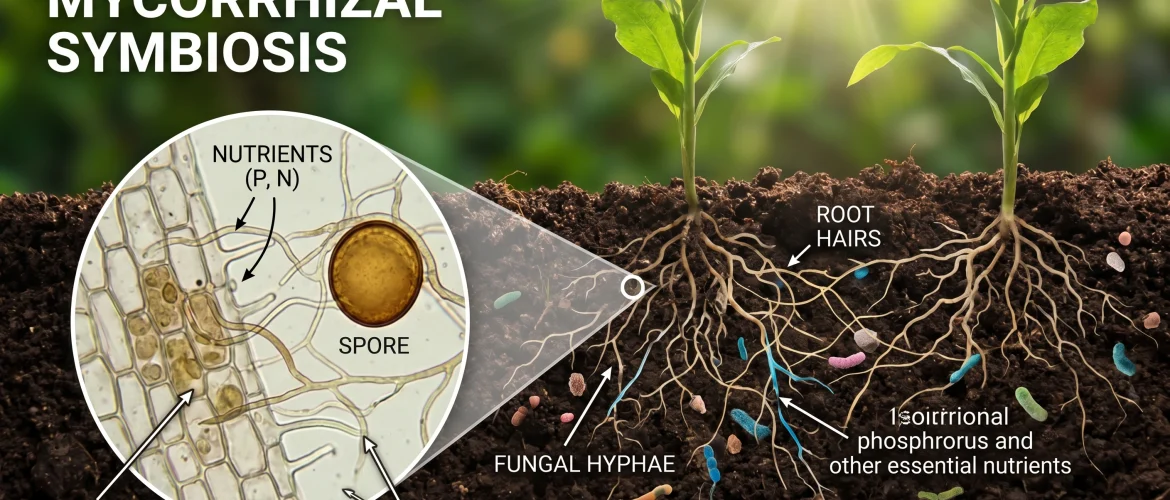
The word “mycorrhiza” literally translates to “fungus-root.” It describes a mutually beneficial, symbiotic relationship between specific soil fungi and the roots of most terrestrial plants. The plant acts as a biological solar panel, using photosynthesis to create liquid carbon (sugars). Then, it trades a portion of these sugars to the fungus.
In exchange, the fungus extends its microscopic threads—called hyphae—far beyond the physical reach of the plant’s roots. Therefore, the plant gains access to water and tightly bound minerals that it could never acquire on its own. Ultimately, fostering this relationship is the most efficient way to maximize nutrient uptake without simply pouring more synthetic fertilizer onto the field.
The Biological Mechanics of Mycorrhizae Soil Health
Moving beyond basic analogies, we must examine the specific biological mechanics driving this symbiosis. When you prioritize mycorrhizae soil health, you are actively engineering the rhizosphere. The vast majority of agricultural crops form relationships with Arbuscular Mycorrhizal Fungi (AMF).
When these specific fungi colonize a root system, they generate several highly measurable physiological benefits:
- Phosphorus Solubilization: AMF exude powerful organic acids and enzymes that unbind phosphorus from calcium or iron in the soil. They then transport this critical macronutrient directly inside the plant’s root cells.
- Glomalin Production: As fungal hyphae grow and die off, they leave behind a sticky glycoprotein called glomalin. This substance acts as biological soil glue, binding micro-aggregates together and massively improving soil structure and aeration.
- Pathogen Defense: By physically occupying the space inside and around the root cortex, beneficial mycorrhizae outcompete soil-borne pathogens, effectively forming a protective biological shield.
How does mycorrhizae improve soil health and structure?
Mycorrhizae improve soil health and structure primarily through the constant production of glomalin and the physical entanglement of soil particles. The microscopic fungal hyphae weave through the dirt, physically pulling loose silt, sand, and clay into stable aggregates. Concurrently, the sticky glomalin coats these aggregates, making them highly resistant to water and wind erosion. Consequently, soils with strong mycorrhizal networks boast superior water infiltration rates, higher oxygen capacity, and a drastically reduced risk of topsoil runoff during heavy rain events.

Building Organic Matter in the Field: A Real-World View
Theoretical science only matters if it solves field-level problems. Consider a crop consultant working in the highly alkaline soils of the American Midwest or parts of Southern Europe. In these environments, high pH levels lock up phosphorus almost instantly. A grower might apply heavy rates of synthetic DAP (Diammonium Phosphate), but a massive percentage of it becomes chemically unavailable within days.
By actively inoculating the seed with high-quality AMF, the grower changes the equation. The fungal hyphae penetrate the microscopic soil pores that plant roots are too thick to enter. According to extensive research published on ScienceDirect, robust mycorrhizal colonization can increase a plant’s effective root surface area by up to 100 times.
The measurable result is profound. Growers utilizing these biological networks consistently report maintaining or increasing crop yields while simultaneously reducing their baseline phosphorus applications by 15% to 25%. Furthermore, as the fungal network expands, it continuously contributes to building organic matter in the soil, creating a compounding return on investment year after year.
Q&A Deep Dive: The Agronomist’s Guide to Fungal Networks
A: The symbiotic relationship between plants and mycorrhizae is a mutualistic biological exchange where both organisms survive and thrive together. The host plant provides the fungus with essential carbohydrates and lipids generated through photosynthesis, which the fungus cannot produce itself. In return, the fungal network acts as an immense secondary root system, scavenging the soil to deliver water, phosphorus, zinc, and other crucial micronutrients back to the host plant.
A: The role of mycorrhizal fungi in drought resistance is primarily driven by their ability to access water trapped in micro-pores deep within the soil profile. Because fungal hyphae are significantly thinner than plant root hairs, they can reach moisture reserves that the plant alone cannot physically access. Additionally, the symbiotic relationship triggers the plant to adjust its osmotic balance, helping the crop maintain cellular turgor pressure and continue photosynthesizing during prolonged dry spells.
A: Yes, excessive applications of highly soluble synthetic fertilizers—particularly phosphorus—can severely harm mycorrhizal colonization. When a plant finds easily accessible, water-soluble phosphorus immediately around its roots, it stops exuding the chemical signals and liquid carbon required to attract and feed the fungus. Consequently, the plant rejects the symbiosis, abandoning the fungal network and becoming entirely dependent on artificial fertilizer inputs.
A: Following a proper application, it typically takes two to four weeks for mycorrhizae to fully establish and colonize the host plant’s root system. The fungal spores must first germinate in response to chemical exudates released by the growing roots. Then, the fungus must physically penetrate the root cortex and begin extending its hyphal network into the surrounding soil before measurable agronomic benefits begin to appear.
How to Apply Mycorrhizal Inoculants to Crops
Integrating biologicals into a commercial farming operation requires precision. If you simply throw spores onto a dry field, you are wasting money. Follow this workflow to ensure successful inoculation and maximize mycorrhizae soil health.
- First, select the correct formulation. Choose an inoculant tailored to your specific crop. Most agricultural row crops require Arbuscular Mycorrhizal Fungi (Endomycorrhizae), while certain tree species, like pines or oaks, require Ectomycorrhizae.
- Next, ensure direct root contact. Mycorrhizal spores must physically touch the germinating root to initiate the symbiosis. Therefore, the most effective application methods are direct seed treatments, in-furrow liquid injections at planting, or root dips for transplants.
- Then, manage your water quality. If you are using a liquid in-furrow system, ensure your tank water is not heavily chlorinated or experiencing extreme pH swings, as harsh water conditions can degrade living spores before they reach the soil.
- After that, temporarily reduce starter fertilizer. To encourage the plant to accept the fungal partnership, reduce your at-planting soluble phosphorus application by roughly 10% to 20%. The plant must feel a slight biological need to seek out the fungus.
- Finally, protect the application. Avoid applying harsh, broad-spectrum soil fungicides immediately after inoculating. While many foliar fungicides are safe, drenching the soil with strong anti-fungal chemistry will quickly terminate your newly applied biological network.
Minimizing disruption to the fungal network in agriculture
The greatest enemy of an established fungal network in agriculture is mechanical tillage. Deep plowing physically slices and shatters the delicate, microscopic hyphal threads that take months to build. Transitioning to no-till or minimum-tillage practices is the single most effective advanced strategy for preserving these biological assets year over year. For professionals looking to master these specific integration strategies, the specialized modules inside Microbial World 101: Plant & Soil Microbiomes- A Hidden World of Crop Solutions provide actionable, field-tested frameworks.

Critical Regulatory and Industry Resources
Navigating the biological agriculture space requires utilizing verified data and understanding shifting global policies. Here are essential resources for modern agronomists:
- The International Biocontrol Manufacturers Association (IBMA): The IBMA is the premier global voice for the biological agriculture industry. Their publications are vital for understanding the standardized quality controls required for reliable mycorrhizal products. Explore their frameworks at ibma-global.org.
- EPA Biopesticide Regulatory Framework: In the United States, understanding regulations for agricultural biologicals is critical. While mycorrhizae are generally treated as soil amendments, any product making pest-control claims falls under strict EPA oversight. Review parameters at epa.gov.
- FAO Global Soil Partnership: The FAO manages an incredible portal dedicated to sustainable soil management. Their global datasets prove exactly why biological integration is necessary for long-term food security. Access updates at fao.org.
- MDPI Open Access Journals: For those seeking deep, peer-reviewed agronomic data, MDPI provides extensive, highly technical studies on the specific genetic interactions between AMF and row crops.
Common Mistakes and Misconceptions
As bio-agriculture scales, misinformation naturally follows. Correcting these errors is essential for professional credibility.
| Myth | Correction |
|---|---|
| Mycorrhizae completely replace the need for fertilizer. | Correction: This is an incredibly dangerous assumption. Fungi do not magically create phosphorus or potassium out of thin air; they simply mine what is already present in the soil profile. If your soil is completely devoid of base nutrients, you must still apply fertilizer. Mycorrhizae simply make those applications drastically more efficient. |
| Native soils already have enough fungi; inoculation is a waste. | Correction: While undisturbed forests have abundant fungal networks, decades of deep tillage, fumigation, and heavy synthetic fertilizer use have virtually eradicated native AMF populations in most commercial agricultural soils. Inoculation is usually required to re-establish the baseline population. |
| You can broadcast mycorrhizae on top of the soil anytime. | Correction: Broadcasting spores on the soil surface is highly ineffective. UV light and dry conditions will rapidly degrade the spores. They must be placed directly in the seed trench or incorporated into the root zone to survive and function. |
Frequently Asked Questions
What types of crops do not respond to mycorrhizal fungi?
Certain plant families are naturally non-mycorrhizal and will not form a symbiotic relationship with these fungi. The most common agricultural examples include the Brassica family (cabbage, broccoli, canola, mustard) and the Amaranthaceae family (spinach, sugar beets). Applying inoculants to these specific crops will not yield a return on investment.
How do you measure mycorrhizae soil health in a commercial field?
The most accurate way to measure colonization is through destructive root sampling. An agronomist will dig up the plant roots, clear them with potassium hydroxide, stain them with a specialized dye, and examine them under a microscope to calculate the exact percentage of root mass colonized by fungal structures.
Are mycorrhizal inoculants safe to use with seed treatments?
Compatibility depends entirely on the specific chemistry of the seed treatment. While most insecticidal seed treatments are highly compatible with mycorrhizal spores, certain aggressive fungicidal seed treatments can inhibit early fungal germination. Always consult the manufacturer’s compatibility matrix before mixing.
Can mycorrhizae survive freezing winter temperatures?
Yes, native and high-quality commercial mycorrhizae are highly resilient. When the host plant dies or goes dormant during winter, the fungus retreats into the form of tough, dormant spores or overwinters inside preserved root fragments. Once the soil warms and new roots emerge in the spring, the spores break dormancy and colonize the new crop.
Conclusion
The shift toward biology-driven farming is not a passing trend; it is the inevitable future of sustainable crop production. By deeply understanding and actively managing mycorrhizae soil health, agronomists and growers can unlock nutrients that have been trapped in their fields for decades. We now have the scientific validation to prove that these microscopic fungal networks drastically improve nutrient use efficiency, build vital organic matter, and shield crops from devastating drought stress.
Moving from reliance on sheer chemical volume to biological efficiency is how we protect both our soil and our bottom line. If you are tired of relying on un-optimized methods and are ready to move past the basic theories and truly master the application of soil biology in commercial agriculture, BAW Academy’s Microbial World 101: Plant & Soil Microbiomes- A Hidden World of Crop Solutions was built exactly for that.
Master Underground Fungal Networks
Unlock trapped soil nutrition and build robust biological resilience directly in your fields with expert-guided frameworks through Microbial World 101: Plant & Soil Microbiomes- A Hidden World of Crop Solutions.
Access Soil Regeneration 101