
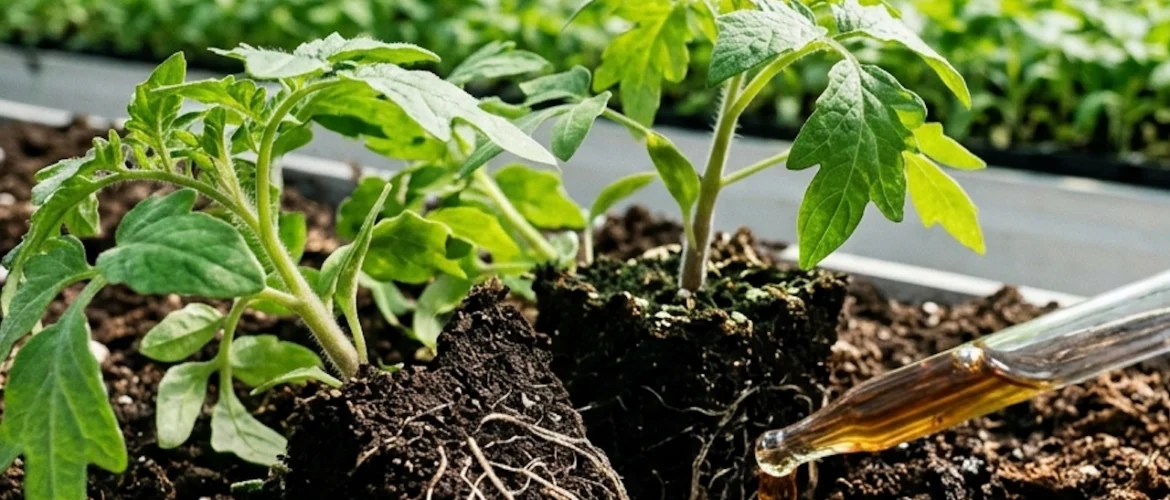
Biostimulants in Agriculture: Beyond Traditional Plant Nutrition
You can pour all the nitrogen you want into the soil, but if the plant is paralyzed by heat stress, that expensive investment simply washes away into the watershed. We often treat agricultural land like a basic checking account: deposit NPK fertilizer, withdraw crop yield. However, any agronomist who has watched a perfectly fertilized corn stand wilt during a two-week dry spell knows this mathematical approach is inherently flawed.
This is precisely where the role of biostimulants in agriculture transitions from a trendy buzzword to an essential agronomic necessity. Rather than feeding the plant directly, these complex substances trigger the plant’s own internal defense mechanisms and optimize its existing biological processes.
By taking a critical, objective look at the science behind these products, we can separate industry hype from verifiable field performance. Let’s break down exactly what these substances are, the biological mechanics driving their efficacy, and how modern agriculture is leveraging them to build resilient cropping systems.
The Core Concept: Moving Beyond Traditional Plant Nutrition
To understand the true benefits of agricultural biostimulants, we must first unlearn a fundamental assumption: that crop health is solely dependent on macronutrients. If synthetic fertilizers are the “food” that provides raw calories for plant growth, biostimulants act as the “probiotics and vitamins” that allow the plant to efficiently digest that food and fend off disease.
A biostimulant is any substance or microorganism applied to plants with the aim of enhancing nutrition efficiency, abiotic stress tolerance, and crop quality traits, regardless of its nutrient content. They do not directly cure diseases, nor do they replace nitrogen, phosphorus, or potassium. Instead, they act as biological catalysts.
For example, when a plant faces drought, its natural response is to close its stomata to conserve water, which halts photosynthesis. Specific biostimulants signal the plant to manage this osmotic stress more efficiently, allowing photosynthesis to continue marginally longer. Consequently, the crop maintains vital biological functions during periods when an untreated plant would simply shut down. Therefore, these tools are not magic cures for poor farming practices; they are optimizers for systems that are already fundamentally sound.

The Science of Stimulation: A Deeper Expert Dive
Evaluating microbial and non-microbial biostimulants requires a critical eye. The agricultural market is flooded with products making sweeping claims, but verifiable efficacy always comes down to specific modes of action. When we examine the peer-reviewed science, high-quality biostimulants in agriculture consistently operate across three primary physiological pathways:
- Enzymatic Activation and Gene Expression: Certain amino acids and peptide-based biostimulants upregulate the genes responsible for stress response. They essentially pre-condition the plant, acting like a biochemical vaccine against impending abiotic stress factors like heat or salinity.
- Root System Development and Architecture: Humic substances and seaweed extracts physically alter root morphology. By promoting lateral root growth and increasing root hair density, the plant exponentially increases its surface area for soil exploration and nutrient interception.
- Microbial Symbiosis: Beneficial fungi (like mycorrhizae) and plant-growth-promoting rhizobacteria (PGPR) exude natural plant growth regulators. These microbes solubilize locked-up soil phosphorus and convert atmospheric nitrogen, trading these essential nutrients for root exudates in a symbiotic exchange.
How do biostimulants work in agriculture during drought conditions?
Biostimulants work during drought conditions by accumulating osmoprotectants—such as proline and complex sugars—within the plant’s cells. This cellular adjustment prevents the plant’s cell walls from collapsing under severe water deficit. Furthermore, specific seaweed extracts trigger the production of antioxidants that neutralize reactive oxygen species (ROS). When a plant experiences severe dehydration, ROS accumulate and destroy healthy tissue. By neutralizing these damaging compounds, the biostimulant preserves the integrity of the plant’s photosynthetic machinery, allowing it to recover rapidly once rainfall finally returns.
Real-World Application: Verifiable Field Results
Theoretical biology means very little to a grower facing tight margins; the data must translate to the field. Fortunately, independent research has begun to systematically validate these biological tools.
Consider the application of seaweed extract biostimulants to crops facing salinity stress. A comprehensive review published in ScienceDirect highlights that applications of Ascophyllum nodosum extracts significantly improve stomatal conductance and chlorophyll retention in salt-stressed tomatoes. The measurable result is a preservation of yield that would otherwise be lost to soil toxicity.
Similarly, widespread field trials utilizing humic acids have demonstrated consistent improvements in phosphorus uptake in highly alkaline soils. Because phosphorus binds tightly to calcium in high pH environments, it becomes unavailable to the crop. Humic acids chelate these micronutrients, keeping them suspended in the soil solution. Consequently, growers achieve higher crop yield without having to increase their baseline synthetic fertilizer application rates. This represents a tangible shift toward sustainable farming practices, driven by hard data rather than ecological idealism. Additional global soil management data can be found via the FAO.
Q&A Deep Dive: The Agronomist’s Guide to Biostimulants
A: The primary difference between biostimulants and biofertilizers lies in their core function. Biofertilizers consist of living microbes that directly add nutrients to the soil through processes like nitrogen fixation or phosphorus solubilization. In contrast, biostimulants in agriculture—which can be either microbial or non-microbial—focus on improving the plant’s physiological ability to uptake those nutrients and tolerate environmental stress. Ultimately, biofertilizers provide the nutrient, while biostimulants optimize the plant’s response.
A: Agricultural biostimulants improve crop abiotic stress tolerance by altering the plant’s biochemical signaling pathways before and during environmental extremes like heat, drought, or frost. They stimulate the production of stress-combating proteins and antioxidants that protect plant cell walls from damage. As a result, the crop maintains basic metabolic functions under harsh conditions, leading to faster recovery and minimal yield loss.
A: The optimal time to apply biostimulants to broadacre crops is preventatively, typically 3 to 5 days before a forecasted abiotic stress event, or during critical physiological growth stages. Applying them during early vegetative growth encourages robust root system development, while applications at the pre-flowering stage help ensure successful pollination under heat stress. Applying biostimulants after a plant is already severely damaged yields significantly lower efficacy.
A: No, biostimulants do not replace the fundamental need for synthetic or organic NPK fertilizers. They contain negligible amounts of macronutrients and cannot supply the physical mass of nitrogen, phosphorus, or potassium required to grow a high-yielding crop. Instead, they increase the nutrient use efficiency (NUE) of the fertilizers you already apply, meaning less fertilizer is wasted through leaching or volatilization.
A: Humic and fulvic acids function as biostimulants in agriculture by physically improving soil structure and chemically chelating essential nutrients. Fulvic acids have a small molecular size, allowing them to carry trace minerals directly through the plant’s stomata or root walls. Humic acids improve soil cation exchange capacity (CEC), holding onto water and nutrients in the root zone so the plant can access them on demand.

A Pragmatic Workflow: Integrating Biostimulants into Existing Systems
Adopting these technologies requires a methodical approach. Tossing a biological product into an existing spray tank without understanding compatibility is a recipe for wasted capital. Follow this critical workflow to ensure successful integration.
- First, diagnose the limiting factor. Identify the specific environmental or nutritional bottleneck your crop faces. Are you fighting soil salinity, chronic drought, or poor phosphorus availability? You cannot select the right biological tool without defining the exact agronomic problem.
- Next, match the mode of action to the problem. If you are addressing poor root mass, select humic substances or mycorrhizal fungi. If you are preparing for a massive heatwave, utilize amino acids or specific seaweed extracts.
- Then, verify physical and biological compatibility. Before mixing a live biological product with a synthetic fungicide or harsh liquid fertilizer, perform a jar test. Many harsh agricultural chemicals will instantly kill living microbial biostimulants upon contact.
- After that, time the application strategically. Biologicals require time to interact with the plant’s physiology. Apply the product preventatively ahead of stress events or strictly during critical growth phases, such as seed emergence or panicle initiation.
- Finally, establish a control strip. Never treat an entire field without leaving an untreated check strip. You must objectively measure the ROI of the biostimulant by comparing root mass, plant vigor, and final yield against the standard practice.
How to manage formulation compatibility with microbial products
When tank-mixing microbial biostimulants, water quality is your most critical variable. Chlorinated municipal water or highly alkaline well water can destroy living spores before they ever reach the soil. Always buffer your tank water to a neutral pH and allow chlorinated water to off-gas before adding microbial products. For those looking to deeply understand the biochemical interactions of tank mixing, the specialized modules within BAW Academy’s curriculum provide the exact laboratory-backed parameters needed to prevent costly application failures.
Critical Regulatory Resources and Industry Tools
The biostimulant market is notoriously difficult to navigate due to inconsistent global regulations. To separate credible products from snake oil, professionals must rely on authoritative industry platforms.
- The European Biostimulants Industry Council (EBIC): A pivotal organization driving the standardization of biostimulant regulations. Visit biostimulants.eu for their database.
- EU Fertilizer Product Regulation (FPR 2019/1009): This is the current gold standard for regulating biostimulants under EU fertilizer product regulation. It explicitly defines a biostimulant by its function (e.g., improving nutrient use efficiency) rather than its composition, providing a critical legal framework that the rest of the world is currently modeling.
Common Mistakes and Misconceptions
| Myth | Correction |
|---|---|
| All seaweed extracts perform the exact same function. | Correction: This is fundamentally false. The efficacy of a seaweed extract is heavily dependent on the specific species harvested (e.g., Ascophyllum vs. Kappaphycus) and the extraction method used (cold-pressed vs. alkaline hydrolysis). Different processes yield entirely different bioactive compounds. |
| Biostimulants will revive a dead or dying crop. | Correction: Biostimulants in agriculture are proactive, not reactive. If a plant has already passed its permanent wilting point, no biological trigger can reverse the cellular death. They must be applied as a preventative measure to build resilience before the stress peaks. |
| You will always see an immediate, visible green-up. | Correction: Unlike a heavy application of synthetic nitrogen, biostimulants often work invisibly below the soil surface. The true benefit is frequently observed in root system development and final yield data, rather than an immediate change in leaf color. |
Frequently Asked Questions
Are biostimulants regulated by the EPA in the United States?
Currently, biostimulants in agriculture sit in a regulatory gray area in the U.S., often regulated at the state level as soil amendments. However, if a product makes explicit claims to control, kill, or repel pests or diseases, the EPA will strictly regulate it as a pesticide, regardless of its biological origin.
Can biostimulants in agriculture improve soil health permanently?
While biostimulants can significantly enhance soil microbial activity and improve soil aggregation in the short term, they do not create permanent fixes. Maintaining optimal soil health requires continuous, holistic management, including crop rotation, cover cropping, and the recurring integration of biological amendments.
What are the main categories of microbial and non-microbial biostimulants?
The primary non-microbial categories include humic and fulvic acids, seaweed extracts, protein hydrolysates, and beneficial chemical elements like silicon. The main microbial categories consist of arbuscular mycorrhizal fungi (AMF), Trichoderma species, and various plant-growth-promoting rhizobacteria (PGPR).
How long does it take for a biostimulant to show field results?
Depending on the mode of action, physiological responses like enzymatic activation can occur within 24 to 48 hours. However, visible agronomic results—such as increased root mass or improved drought tolerance—typically take one to three weeks to manifest visibly in the field.
Conclusion
The integration of biostimulants in agriculture represents a necessary evolution in how we manage crop production. By shifting our focus from simply force-feeding plants to actively optimizing their physiological responses, we can mitigate the devastating impacts of abiotic stress and improve overall nutrient use efficiency. The data is clear: when applied with critical, scientific precision, these biological tools are not optional luxuries, but essential components of resilient agronomy.
However, mastering this science requires moving beyond basic marketing brochures. If you’re ready to go from understanding the foundational theory to confidently applying it in the field, BAW Academy’s Biostimulants 301: From Discovery to Market was built exactly for that.
Master the Science of Biostimulants
Advance your agronomic expertise with professional certification.
Enroll in Biostimulants 301