
Blog
The Invisible Language of Nature, Inside Our Semiochemicals Deep Dive
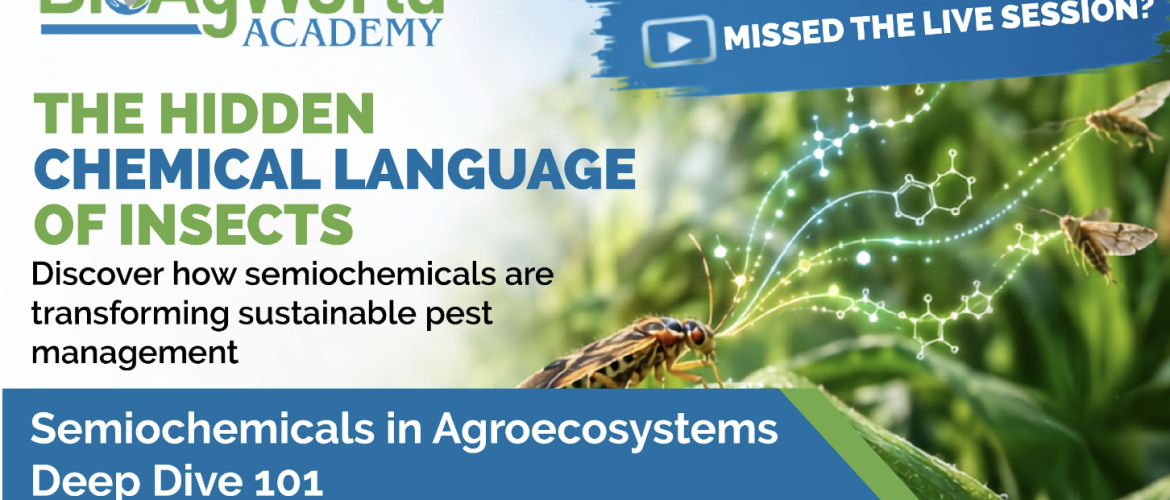
The Invisible Language of Nature: Inside Our Semiochemicals Deep Dive
Walk into a typical agricultural field on a quiet morning, and it might seem incredibly still. But right beneath our level of human perception, a complex and high-stakes conversation is taking place every single second.
For a long time, we thought of plants as passive organisms simply waiting to be consumed by pests. We now know this could not be further from the truth. To survive in a harsh world, plants have developed vast chemical vocabularies to interact with their environment, deter enemies, and recruit biological allies to protect them. Insects, in turn, have evolved to intercept, interpret, and sometimes weaponize these exact same signals.
It is a fascinating, invisible biological arms race. These unseen drivers of the agricultural biome are known as semiochemicals, derived from the Greek word meaning signal.
About the Masterclass
We recently explored this hidden world in our BAW Academy course: Semiochemicals in Agroecosystems Deep Dive 101: From Biology to Sustainable Pest Management. Led by Knowledge & Training Partners including Dr. Markandeya Gorantla (ATGC Biotech) and Thaís Andrade, PhD (Provivi), the sessions examined how chemical cues operate in fields and why understanding them opens up precise, sustainable pest management approaches.
To give you a glimpse into this learning experience, here is a practical Q&A breakdown based on the most impactful moments from the course:
01. What exactly is chemical espionage in the field?
One of the most striking concepts discussed during the training was how pests have evolved to turn a plant’s own defense mechanisms against it—a biological phenomenon known as chemical espionage.
When certain plants or trees are stressed by an attack, they release natural defensive signals into the air. While intended to ward off attackers or recruit beneficial predators, certain insects have learned to intercept this specific chemical distress signal.
Through microscopic processes in the insect’s gut, the plant’s defense signal is metabolized and converted into a highly potent aggregation pheromone. The pest effectively uses the host’s own chemistry to broadcast a signal that calls thousands of other pests to the vulnerable plant. Understanding these precise interactions is the first step in engineering methods to disrupt them.
02. How does this shift our approach to sustainable pest management?
Conventional control typically relies on broad-spectrum lethal toxicity—eradicating organisms wholesale. Semiochemicals represent a fundamental shift: smart behavioral management over brute-force knockdown.
Instead of relying on a single toxic chemistry, integrated programs flood the canopy with synthetic signals to scramble pest host-location mechanisms:
- Mating Disruption: Targeted pheromones confuse male pests, preventing mating pairs from forming and cutting reproductive cycles.
- False Plant Trails: Lures draw pests away from valuable cash crops toward non-critical perimeters.
- Repellents: Natural deterrent cues trick pests into assuming the host plant is already overcrowded or unviable.
03. Why is the exact shape of a chemical so critical?
Synthesizing agricultural pheromones requires strict molecular precision. It is not just about matching a chemical formula on paper; the three-dimensional, spatial shape of the molecule is decisive.
Insect olfactory receptors operate with extreme specificity. The course detailed how positive and negative enantiomers (molecules that are exact mirror images of each other) can trigger entirely divergent behavioral responses in an insect.
Think of it as a lock and key. If the synthesized chiral structure is slightly off, the key will not fit the receptor, rendering the formulation ineffective in field conditions. This structural reality separates viable bio-agricultural formulations from unsuccessful lab runs.
04. How can these solutions be applied on massive commercial farms?
Understanding biology is only part of the equation. A primary challenge in scaling biologicals is field application efficiency. If a solution cannot be deployed across hundreds of hectares economically, practical adoption stalls.
The course examined modern mechanized and aerial application technologies that move well beyond manual branch dispensers:
- Tractor-Mounted Systems: Deploy specialized flowable micro-encapsulations and sprayable formulations uniformly during routine field passes.
- Fixed-Wing Aircraft: Provide rapid, cost-effective treatment across vast, contiguous monocultures and dense canopies.
- Precision Drones: Apply targeted drops directly over identified pest hotspots, minimizing chemical volume while optimizing localized control.
05. Does behavioral control replace traditional field scouting?
No. Behavioral management like mating disruption suppresses populations and disrupts reproductive cycles, but it does not eliminate the necessity of on-the-ground field scouting.
Growers must continue to monitor actual trap counts, verify disruption efficiency, and evaluate population thresholds to decide if supplemental interventions are required. Semiochemicals strengthen Integrated Pest Management (IPM), but they work alongside, rather than replace, regular crop monitoring.
06. Understanding the global regulatory landscape
Translating biological breakthroughs into commercial tools requires a clear grasp of regulatory compliance. The course covered baseline differences across global frameworks (including the US EPA, EU regulations, and regional ag agencies).
Rigorous criteria around product identity verification, preliminary 5-batch analysis, and standardized manufacturing protocols are just as critical to a product’s launch as field efficacy. Without clear regulatory pathways, effective scientific solutions remain confined to laboratory settings.
Continue Exploring with BAW Academy
This recap offers just a preview of the biological mechanisms, field application methods, and regulatory frameworks covered in the full curriculum. Expand your technical foundation in behavioral pest management.
Led by industry specialists from ATGC Biotech, Provivi, and BAW Academy.